Crochet gauge calculator & swatch guide
Count the stitches and rows in your own sample. Convert them to a standard gauge, then carry the numbers into a ball pattern or blanket plan.
What did you measure?
Measure the center of your sample without stretching. Width is the horizontal span you counted; height is the vertical span. They can be different.
4 in is 10.16 cm, so the equivalent per-10cm count differs slightly.
The ball link starts with a 3 in / 8 cm draft; the blanket link starts with 30 × 36 in / 75 × 90 cm. Change the finished size on the next screen. The ball tool uses stitch gauge only; row gauge is passed to the blanket tool.
How to measure crochet gauge
- Make a sample with the yarn, hook, stitch and tension you intend to use. Leave enough extra fabric to measure away from the edges.
- Let it relax. Wash or block it as appropriate for the finished project, then measure without stretching.
- Count stitches across a central span and rows down a central span. Enter the actual span you measured, not the total size of the sample.
- Record the units. Fractional stitches are allowed at the measurement boundary. A wider span usually reduces the impact of a counting error.
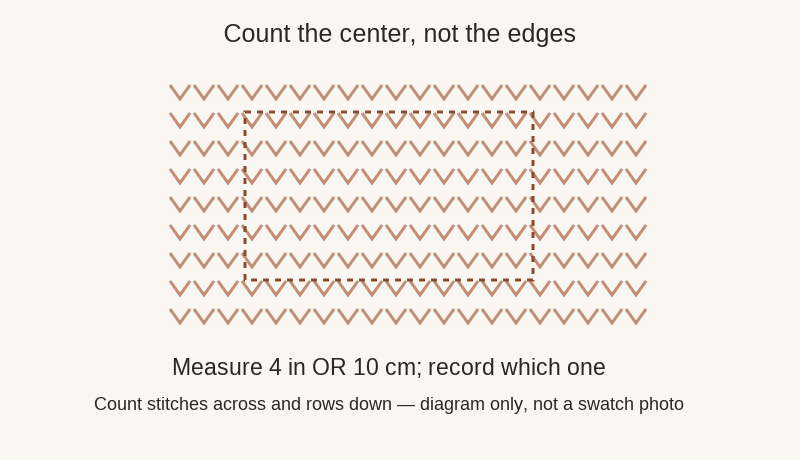
A flat single-crochet sample is a starting estimate for a toy. Your tension in continuous rounds may differ. If possible, compare with an even section worked in the round using the same materials.
Three examples you can check
| Measured sample | Stitch gauge | Row gauge |
|---|---|---|
| 20 stitches across 4 in; 22 rows down 4 in | 5 stitches/in | 5.5 rows/in |
| 10 stitches across 2 in; 11 rows down 2 in | 20 stitches/4 in | 22 rows/4 in |
| 20 stitches across 10 cm; 22 rows down 10 cm | 2 stitches/cm | 2.2 rows/cm |
Formula: stitches counted ÷ measured width = stitches per unit. Rows counted ÷ measured height = rows per unit. Multiply by 4 for a four-inch gauge or by 10 for a ten-centimeter gauge, after converting units if needed.
Are 4 inches and 10 centimeters the same?
No. Four inches equals 10.16 centimeters. A density of 20 stitches per 4 in becomes approximately 19.685 stitches per 10 cm. The same numeric count over 10 cm describes a slightly tighter gauge.
From gauge to a crochet ball
For a 3-inch ball at 20 stitches per 4 inches, the estimated middle circumference needs 3 × (20 ÷ 4) × π ≈ 47 stitches. The current classic recipe rounds to 48 stitches and produces 22 rounds. Try the 3-inch ball example.
Stitch gauge estimates circumference. Row height, tension and stuffing also affect shape. Neither ball mode guarantees an exact sphere; the geometric mode has not been physically validated.
From gauge to a blanket
At 20 stitches and 22 rows per 4 inches, a 30 × 36 inch rectangle needs 150 stitches and 198 rows. For the tool’s single-crochet convention, start with 151 chains. Borders and pattern repeats are not included. Open this blanket plan.
Why your sample matters
The yarn label or someone else’s hook size cannot replace your own gauge. Different stitch patterns and tension change fabric density. If your width matches but height does not, check row gauge separately rather than changing both numbers together.
If you already know your required stitch counts, use the even increase and decrease calculator to distribute a change across a row or round.
Method and sources
This calculator divides your counts by your measured spans and uses the exact conversion 1 in = 2.54 cm. Arithmetic is checked in software; that does not validate a physical finished object. Craft Yarn Council’s crochet gauge guide explains why checking a sample matters. About CrochetMath.